







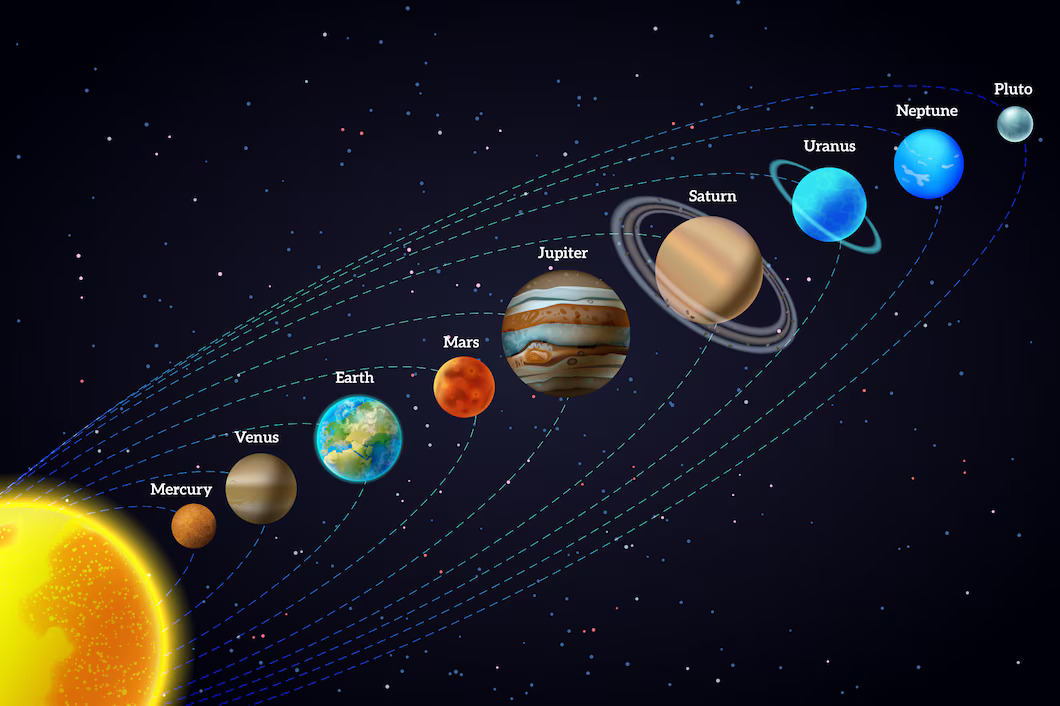
While the faster-moving planets — like Mercury, Venus, and Mars — influence short-term trends and daily moods, it is the outer planets that shape the deep architecture of history. In mundane astrology, these slow-moving celestial giants — Uranus, Neptune, and Pluto — govern the long tides of civilization: revolutions, ideologies, and the transformation of human consciousness itself.
These are the generational planets — so called because their effects transcend individual lives, molding the collective psyche of entire generations. Each of these outer planets lingers in a sign for years or even decades, gradually seeding new cultural, political, and technological paradigms.
Their movement represents the larger storylines of humanity — the slow unfolding of destiny that spans centuries.
Uranus: The Awakener of Revolution and Innovation
In generational astrology, Uranus represents sudden liberation, technological advancement, and rebellion against the old order. Discovered in 1781, just as revolutions were erupting across the Western world, Uranus embodies the spirit of freedom and progress. Its 84-year orbit defines the rhythm of societal reform and scientific breakthroughs.
When Uranus changes signs, we witness collective awakenings:
- Uranus in Gemini (1941–1949) – The birth of modern communication technology and the dawn of the information age.
- Uranus in Aquarius (1996–2003) – The rise of the internet, digital connectivity, and global consciousness.
- Uranus in Taurus (2018–2026) – The redefinition of value, currency, and sustainability — echoing the rise of cryptocurrency and the climate movement.
In mundane astrology, Uranus disrupts and innovates. Wherever it transits in a national chart, that sector experiences shocks and breakthroughs. In global transits, it catalyzes the collective nervous system, sparking revolutions both technological and ideological.
Neptune: The Dreamer and Dissolver of Illusions
Neptune, discovered in 1846, moves even more slowly — about 165 years per full orbit. It governs spirituality, idealism, art, and collective dreams. In outer planet mundane astrology, Neptune’s influence is subtle yet profound, often manifesting through the shaping of mass consciousness and belief systems.
When Neptune changes signs, the world’s spiritual and creative focus transforms:
- Neptune in Sagittarius (1970–1984) – The explosion of global spirituality, yoga, and new-age movements.
- Neptune in Capricorn (1984–1998) – The illusion of corporate utopia and economic idealism that culminated in globalization.
- Neptune in Pisces (2011–2026) – The age of empathy, illusion, and digital escapism — where boundaries between virtual and real dissolve.
Neptune inspires art, compassion, and higher ideals, but it can also create confusion and deceit. Its transits correspond with waves of mass delusion, propaganda, or spiritual awakening — depending on humanity’s level of awareness.
In generational astrology, Neptune defines what a generation believes in, dreams about, and aspires toward — whether that’s utopia, technology, or transcendence.
Pluto: The Lord of Power, Death, and Rebirth
At the farthest edge of the solar system, Pluto represents transformation at its most profound. Its 248-year orbit moves through each sign for decades, marking the rise and fall of empires and ideologies. In mundane astrology, Pluto is the alchemist — destroying what is decayed so that renewal may occur.
Each Pluto sign generation carries a distinct evolutionary mission:
- Pluto in Leo (1939–1957) – The age of personal power, celebrity, and post-war individualism.
- Pluto in Virgo (1957–1972) – The era of service, health, and environmental awareness.
- Pluto in Scorpio (1983–1995) – The digital underworld generation, obsessed with truth, intensity, and transformation.
- Pluto in Aquarius (2023–2043) – A revolutionary age of decentralization, AI ethics, and the rebirth of collective ideals.
Pluto’s transits over national charts often coincide with times of crisis and rebirth. For instance, the United States Pluto return (2022–2025) mirrors the same transformative energy present during its founding in 1776 — a time of reevaluation of power, justice, and purpose.
Pluto strips away illusions of control, forcing humanity to face the shadow side of power — be it political corruption, economic inequity, or environmental collapse. Yet through that destruction comes regeneration and renewal.
The Dance of the Slow Planets: Global Turning Points
When the generational planets form aspects to each other — such as Uranus square Pluto or Neptune conjunct Saturn — the world undergoes seismic changes. These alignments form the backdrop of world astrology, marking decades of transformation.
For example:
- Uranus–Pluto Conjunction (1965–66): The counterculture revolution, civil rights movements, and artistic liberation.
- Neptune–Uranus Conjunction (1993): The birth of the internet and the merging of science with imagination.
- Saturn–Pluto Conjunction (2020): Global lockdowns and systemic restructuring — a rebirth of collective discipline.
These slow planet effects act like tectonic shifts beneath the surface of civilization. While the personal planets define the weather, the outer planets define the climate — the long-term currents that guide evolution.
Generational Planets and Collective Evolution
In generational astrology, the outer planets correspond to the three great stages of collective transformation:
- Uranus: Awakening — the lightning strike of insight and rebellion.
- Neptune: Dissolution — the melting of boundaries and the awakening of compassion.
- Pluto: Regeneration — the death of the old and the birth of the new.
Together, they illustrate the alchemical journey of humanity’s soul. Each generation inherits the unfinished lessons of the last — collectively evolving through crisis, creativity, and consciousness.
Conclusion: The Long View of Time
The outer planets in mundane astrology remind us that civilizations are living entities with their own karmic rhythms. They rise, evolve, and eventually transform — guided by the long arcs of Uranus, Neptune, and Pluto.
By observing these slow planets, astrologers don’t merely predict — they interpret the unfolding story of the collective soul.
In their cycles, we glimpse the deeper intelligence of the cosmos — a reminder that history itself is not random, but the gradual awakening of humanity under the eternal gaze of the stars.